

Reflow Soldering Conveyor Speed Explained: How to Optimize SMT Quality and Throughput
Dec 03, 2025
Reflow soldering conveyor speed is one of the most critical yet often underestimated parameters in SMT assembly. It directly affects heat transfer, solder joint formation, and overall production efficiency. An improperly set speed can lead to defects such as cold solder joints, excessive voiding, PCB warpage, or component damage.
In this article, we explain what reflow soldering conveyor speed is, how it impacts soldering quality, and how to optimize it in real production environments-based on practical experience from TECOO's SMT workshop.
What Is Reflow Soldering Conveyor Speed?
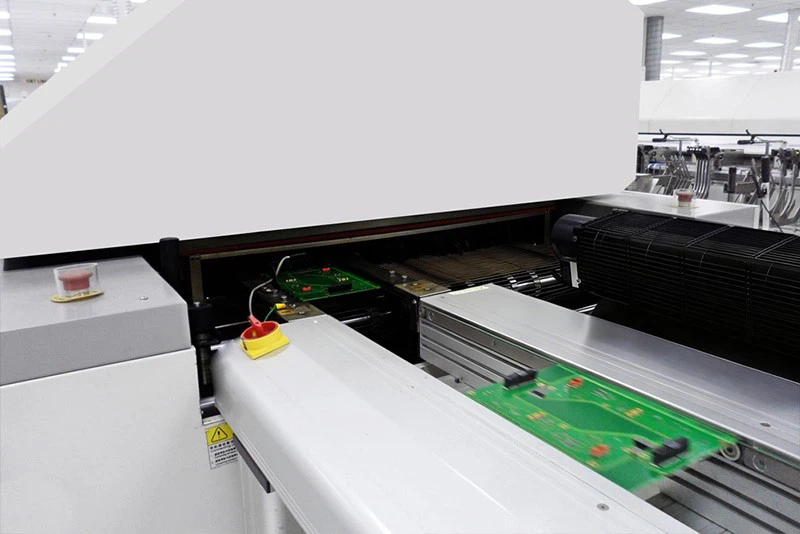
Reflow soldering conveyor speed refers to the rate at which a PCB travels through the heating zones of a reflow oven. It is typically measured in centimeters per minute (cm/min) or inches per minute (in/min).
Conveyor speed does not operate independently. It works together with:
- Reflow temperature profile
- Flux activation behavior
- PCB thermal mass
- Component type and layout
Together, these factors determine whether solder joints form correctly and reliably.
Why Conveyor Speed Is Critical in the Reflow Soldering Process
Control of Thermal Dwell Time
Conveyor speed defines how long the PCB remains in each zone of the reflow oven, including:
- Preheating
- Soaking
- Reflow (time above liquidus)
- Cooling
Accurate speed control ensures uniform heating, proper solder paste melting, and sufficient gas release. This helps prevent defects such as non-wetting, tombstoning, or cold joints.
Risks of Incorrect Conveyor Speed
- Too fast:
Insufficient preheating, incomplete flux activation, trapped volatiles, and higher void rates.
- Too slow:
Component overheating, PCB deformation, flux carbonization, and reduced throughput.
Key Factors That Influence Reflow Conveyor Speed Settings
PCB Design and Materials
Board thickness, layer count, copper distribution, and substrate type (e.g., FR-4 or high-frequency materials) determine thermal capacity. Thicker or copper-heavy boards generally require slower conveyor speeds to ensure heat penetration.
Component Type and Layout
High-density assemblies using BGA, QFN, or fine-pitch components demand tighter thermal control. Slower speeds help achieve uniform soldering and reduce the risk of defects.
Solder Paste Characteristics
Different solder alloys (such as SAC305 or SnPb) and flux systems have unique melting points and activation windows. Conveyor speed must align with the solder paste's recommended reflow profile.
Reflow Oven Design
Hot-air convection, infrared, and hybrid reflow ovens have different heat transfer efficiencies. Conveyor speed must be calibrated according to the oven's heating method and airflow characteristics.
How Conveyor Speed Affects Soldering Quality
Defects Caused by Excessive Speed
- Poor solder wetting: Flux does not fully activate, leading to weak or incomplete joints.
- Thermal stress cracking: Rapid temperature changes increase the risk of microcracks, especially in ceramic components and large ICs.
- Increased voiding: Volatiles cannot escape in time and become trapped in molten solder.
Issues Caused by Excessively Slow Speed
- Component and PCB damage: Prolonged exposure to high temperatures can harm heat-sensitive parts or cause PCB discoloration and delamination.
- Flux residue carbonization: Hard residues may interfere with electrical testing and long-term reliability.
- Lower production efficiency: Reduced conveyor speed directly limits output and increases unit cost.
Best Practices for Optimizing Reflow Soldering Conveyor Speed
Speed Optimization Based on PCB Characteristics
1. Start with thermal profiling
Use thermocouples or profiling tools to measure temperature curves at different speeds. Ensure peak temperature and time above liquidus meet solder paste specifications.
2. Use segmented process control
Modern reflow ovens allow zone-based optimization. For example:
- Slower speed in the preheating zone for uniform temperature rise
- Optimized speed in the reflow zone to limit high-temperature exposure
3. Follow solder paste recommendations
Use the supplier's recommended thermal profile to calculate a suitable speed range, typically allowing a ±10% adjustment margin.

Coordinated Adjustment of Reflow Oven Parameters
-
Temperature and speed synchronization:
Increasing conveyor speed requires higher zone temperatures to maintain sufficient thermal input.
-
Airflow optimization:
In forced-convection ovens, higher airflow improves heat transfer but must be controlled to avoid displacing small components.
-
Conveyor system calibration:
Regularly inspect chain or mesh belts to ensure stable, vibration-free operation.
Process Monitoring and Continuous Improvement
-
Real-time profiling:
Use temperature profiling systems (e.g., KIC) to continuously track actual thermal curves.
-
AOI and SPI correlation:
Analyze solder joint defects and paste volume data alongside conveyor speed to identify process trends.
-
DOE-based optimization:
Apply Design of Experiments (DOE) for new products to define robust speed windows and standardize processes.
Real-World Applications from TECOO's SMT Workshop
Case 1: High-Speed Communication PCBs
- Challenge: 2.4 mm thick PCB with multiple ground layers showed cold solder joints at edges.
- Solution: Reduced speed from 85 cm/min to 70 cm/min and increased preheat temperature by 10°C.
- Result: Void rate dropped from 15% to under 5%, with visibly improved solder joint quality.
Case 2: Miniature Wearable Electronics
- Challenge: Thin 0.6 mm PCBs deformed at high speed and suffered thermal damage at low speed.
- Solution: Mesh belt conveyor at 65 cm/min, reduced airflow, and added support fixtures.
- Result: Yield increased from 92% to 99.5%, with warpage controlled below 0.1%.
Case 3: Mixed Leaded and Lead-Free Assembly
- Challenge: Conflicting thermal requirements on the same PCB.
- Solution: Set a baseline speed of 75 cm/min and used selective thermal insulation for leaded areas.
- Result: Reliable solder joints for both alloys and a wider process window.
Conclusion: Conveyor Speed Is a Strategic SMT Process Parameter
Reflow soldering conveyor speed is not just a numeric setting-it is a strategic parameter that integrates thermodynamics, materials science, and equipment performance. At TECOO, we use a data-driven, engineering-focused approach to align conveyor speed with the entire SMT process chain, ensuring high soldering quality and efficient mass production.
As IoT-enabled equipment and AI-driven process control continue to evolve, adaptive and real-time conveyor speed optimization will play a key role in the future of intelligent SMT manufacturing.