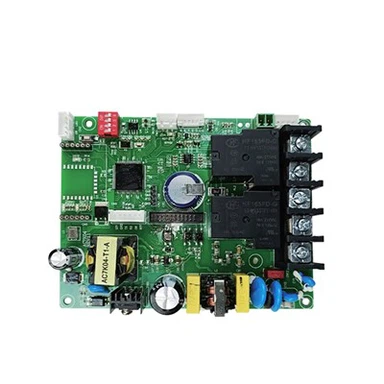


What are the protection functions of the servo driver board?
Apr 11, 2026
The servo drive board, as the core component of industrial automation system, is designed to ensure the stable operation of the equipment under complicated conditions, and to prolong the service life of the hardware and ensure the safety of operation. The following is a systematic classification explanation of its main protective functions:
1.Electrical safety protection
Overvoltage/Undervoltage Protection
Monitor input power voltage in real time. When the voltage exceeds the rated range (e.g. power grid fluctuations or power supply failures), a protection mechanism is automatically triggered to prevent the drive from being damaged or performance degradation due to voltage anomalies. Overcurrent protection
The current of the motor is detected in real time by the current sensor. When the current exceeds a safety threshold (such as a sudden change in load or a short circuit), immediately limit the output current or cut off the power supply to prevent overheating and damage to electrical equipment (such as IGBT).
Ground fault protection
Check the insulation status between the drive plate and the ground. In case of leakage or faulty grounding, the circuit should be quickly disconnected to prevent the risk of electrocution and to protect the equipment from electrical corrosion.
ii. Mechanical and thermal protection
Overload Protection
By combining current feedback with dynamic model, the overload state of motor is determined. Reduce output power or close motor and drive plates to protect them from mechanical stress damage. Overheat protection
Built-in temperature sensor monitor the temperature of key components such as power modules and radiators. When the temperature nears the safe limit, activate the cooling fan to speed up cooling or force the machine to shut down to prevent heat loss and hardware failure.
Speed protection
Through encoder feedback, the motor speed is monitored in real time. When the speed exceeds the set safe value (such as lossof control or encoder failure), the power supply should be cut off immediately and an alarm should be triggered to prevent the equipment from being damaged by high-speed rotation.

III. Protection of signals and communications
Encoder Fault Protection
Continuous monitoring of encoder signal quality (e.g. pulse loss, phase error). When an anomaly is detected, switch to safe mode (such as deceleration or shutdown) to prevent position control failures and potential accidents.
Communication Interruption Protection
In the case of bus communication or analog quantity control, when communication between the host machine and the driver board is interrupted, default security policies (such as maintaining final status or emergency shutdown) are automatically implemented to ensure system controllability.
Parameter anomaly protection
Performs range checks on user-set parameters (such as acceleration time, torque limit), refuses to execute and displays error messages when the parameters exceed a reasonable range to prevent the device from getting out of control due to an operational error.
IV. INTRODUCTION Environmental Adaptability Protection
Dust/Waterproof Design
Adopt a sealed structure or protective coating to prevent dust and moisture from entering the drive plate, thus avoiding the risk of short circuit or corrosion, and can be adapted to harsh industrial environments.
Anti-electromagnetic Interference (EMI)
Filter circuit, shielding layer and grounding design are utilized to reduce the influence of external electromagnetic interference on the drive signal, while reducing the electromagnetic radiation of the drive itself to ensure compatibility and operation with other devices.
Vibration/Shock Tolerance
Optimize circuit board layout and element fixation to improve mechanical strength, prevent solder joints from loosening or elements from shifting due to vibration or shock, and ensure long-term reliability.

V. Software and Logic Protection
Watchdog Timer
Monitor the internal software performance of the drive board. When a program enters an infinite loop or runs erratically, it automatically resets the system and returns to a secure initial state to prevent successive failed outputs.
Safe Torque Off (STO)
It complies with international safety standards and performs emergency shutdown functions through separate hardware circuit, ensuring that the motor immediately stops producing torque in dangerous situations.
Record and diagnosis of malfunctions
Stores historical fault codes and operation data. Support for checking the cause of the fault through the host or display interface to help with quick maintenance and prevent similar problems from recurring.