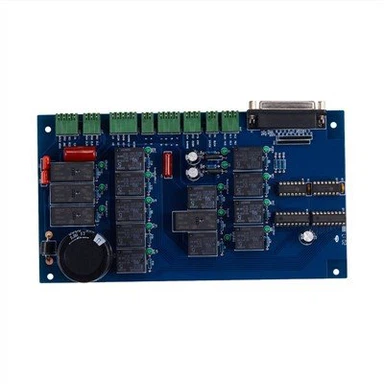


The heat dissipation design of the servo driver board is crucial to its stable operation. What are the common heat dissipation methods and their advantages and disadvantages?
Apr 10, 2025
The heat dissipation design of the servo driver board is crucial to its stable operation. Common heat dissipation methods include natural heat dissipation, air cooling, liquid cooling, heat pipe cooling, and semiconductor cooling. The following is an analysis of the advantages and disadvantages of these heat dissipation methods:
Natural Heat Dissipation
Principle: Through metal structures such as heat sinks and heat fins, heat is dissipated into the environment by natural convection of air.
Advantages:
Simple structure: No additional power source is required, resulting in low cost and high reliability.
Convenient maintenance: There are no moving parts, so the failure rate is low, and maintenance costs are minimal.
Silent operation: As there are no active parts such as fans, it operates without noise.
Disadvantages:
Low heat dissipation efficiency: Greatly affected by ambient temperature and airflow, suitable for low-power and small-sized driver boards.
Large volume: To improve heat dissipation efficiency, a larger heat dissipation area is required, which increases the size of the equipment.
Air Cooling
Principle: Force airflow through a fan to accelerate heat dissipation.
Advantages:
High heat dissipation efficiency: The fan can force airflow, significantly improving heat dissipation efficiency.
Moderate cost: Mature technology with relatively low cost, suitable for medium-power driver boards.
Disadvantages:
Noise problem: The fan generates noise during operation, which may affect the use environment of the equipment.
Life limit: The fan is a moving part, which is prone to wear and failure and requires regular maintenance.
Dust accumulation: The fan may bring in dust when inhaling air, which affects the heat dissipation effect and the lifespan of the equipment.

Liquid Cooling
Principle: Heat is taken away by circulating liquid (such as water or coolant).
Advantages:
Extremely high heat dissipation efficiency: The liquid has a large specific heat capacity, and the heat dissipation efficiency is much higher than that of air. Suitable for high-power driver boards.
Uniform temperature: Liquid circulation can evenly take away heat, avoiding local overheating.
Disadvantages:
Complex structure: Components such as water pumps, radiators, and pipes are required, making the system complex and costly.
High maintenance cost: The liquid may leak, requiring regular inspection and maintenance, resulting in high maintenance costs.
High environmental requirements: There are certain requirements for ambient temperature and humidity, and the liquid needs to be prevented from freezing or evaporating.
Heat Pipe Heat Dissipation
Principle: Heat is transferred by using the phase change (evaporation and condensation) of the working fluid in the heat pipe.
Advantages:
Efficient heat transfer: Heat pipes have high heat transfer efficiency and can quickly transfer heat from the heat source to the heat sink.
Adaptability: Heat pipes can be bent and are suitable for equipment with limited space or complex layouts.
Disadvantages:
High cost: Heat pipe technology is complex, and the cost is high.
Depends on gravity: Heat pipe performance is affected by gravity and needs to be installed in a reasonable direction.
Difficult maintenance: After the working fluid inside the heat pipe leaks, the performance decreases, and maintenance is difficult.
Semiconductor Heat Dissipation (TEC)
Principle: Using the Peltier effect, the semiconductor material is driven by current to generate a temperature difference, achieving active cooling.
Advantages:
Active cooling: It can achieve local low temperatures and is suitable for temperature-sensitive components.
Fast response speed: The cooling effect is rapid and is suitable for instantaneous high-power consumption scenarios.
Disadvantages:
High energy consumption: TEC requires continuous power supply and has high energy consumption.
High cost: TEC modules are expensive and are suitable for high-end equipment.
High heat dissipation requirements: The heat generated by TEC itself needs to be dissipated by other means, increasing the complexity of the system.