

The Unseen Brain: How Automatic Doors Know When to Open
May 23, 2025
We walk through them every day, often without a second thought. That familiar swish as a door glides open, seemingly anticipating our arrival. While it feels like magic, it's actually the result of sophisticated engineering and a hidden "brain" known as the automatic door control system.

At its core, an automatic door needs to do three things: detect your presence, decide to open, and then execute that command smoothly and safely. Let's pull back the curtain and explore the fascinating science behind this everyday convenience.
The Door's Senses: More Than Meets the Eye (or Ear!)
Before a door can open, it needs to "know" you're there. This is where a variety of sensors come into play, acting as the door's eyes and ears:
- Infrared Sensors: Think of these like silent watchdogs. They emit invisible infrared light and "listen" for reflections. When you walk into their field, the reflected light changes, signaling your presence. Some advanced infrared sensors can even detect your body heat.
- Microwave Sensors (Radar): These work on a similar principle to radar, bouncing microwave signals off objects. They're excellent at detecting movement over a wider area, picking up even subtle shifts in your position.
- Ultrasonic Sensors: Using high-frequency sound waves, these sensors are like tiny bats, emitting pulses and listening for the echo. The time it takes for the echo to return tells the door how far away you are.
- Pressure Sensors: Often embedded in floor mats, these are the simplest form of detection. When you step on the mat, the pressure activates a switch, triggering the door.
- Optical Sensors (Light Curtains): Imagine an invisible fence across the doorway. If you break this light beam, the door knows you're there. These are often used as safety features to prevent the door from closing on someone.
Modern automatic doors often employ a combination of these sensors, creating a more robust and reliable detection system. For instance, a microwave sensor might trigger the initial opening, while an infrared "presence" sensor keeps the door open as you pass through.
The Brain on a Board: The PCBA
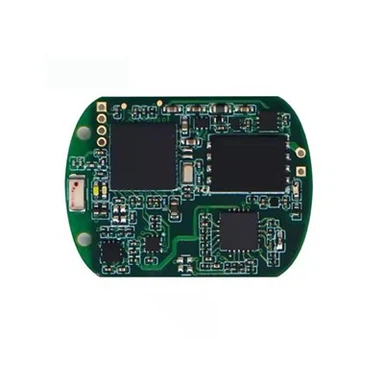
Once a sensor detects your presence, that information needs to be processed. This is where the Printed Circuit Board Assembly (PCBA) comes into play. You can think of the PCBA as the "brain" of the automatic door.
A PCBA is essentially a non-conductive board (often green or brown) with intricate copper pathways printed on it. Electronic components – resistors, capacitors, microcontrollers, and more – are then soldered onto these pathways. In an automatic door's control system, the PCBA houses the crucial components that:
- Receive and interpret sensor data: The PCBA takes the raw signals from the various sensors and translates them into meaningful information.
- Execute opening and closing commands: Based on the sensor data and pre-programmed logic, the PCBA sends commands to the door's motor.
- Manage safety protocols: This is paramount. The PCBA is programmed with algorithms that dictate safe operation, such as stopping and reversing if an obstruction is detected, or maintaining a safe hold-open time.
- Control motor speed and force: The PCBA regulates the power delivered to the motor, ensuring smooth, controlled opening and closing speeds.
Without a well-designed and robust PCBA, the automatic door would be nothing more than a collection of disconnected parts. It's the central hub where all the input from the sensors is processed and translated into the precise actions of the door.
From Thought to Action: The Motor and Mechanics
With the decision made by the PCBA, the next step is physical movement. This is handled by the motor and mechanical systems:
- Electric Motors: These powerful components provide the force to move the door panels. Whether sliding or swinging, the motor translates electrical energy into mechanical motion.
- Drive Systems: Belts, gears, and rollers work in conjunction with the motor to convert its rotational movement into the linear or swinging motion required to open and close the door smoothly along its tracks.
Safety First: The Unsung Heroes
Beyond simply opening and closing, automatic doors are engineered with a strong emphasis on safety. The control system, heavily reliant on the PCBA, manages critical safety features:
- Auto-Reverse: If the door senses an obstruction while closing (via a pressure-sensitive edge or other sensors), the PCBA immediately commands the motor to stop and reverse direction, preventing injury or damage.
- Hold-Open Timers: The door will remain open for a set period, or as long as a person is detected in its path, preventing premature closing.
- Emergency Stop: Many doors include manual buttons to immediately halt operation in an emergency.
The Future is Smarter
As technology advances, so too do automatic door control systems. We're seeing integration with:
- Artificial Intelligence: AI can analyze traffic patterns, predict peak times, and even optimize door opening and closing speeds for energy efficiency and smoother flow.
- Internet of Things (IoT): Doors can be connected to central building management systems, allowing for remote monitoring, diagnostics, and predictive maintenance.
- Touchless Activation: "Wave-to-open" sensors and biometric access control are becoming more common, enhancing hygiene and security.
So, the next time you glide through an automatic door, take a moment to appreciate the unseen "brain" – the sophisticated control system and its indispensable PCBA – that makes this everyday convenience possible. It's a testament to how science and engineering seamlessly integrate to make our lives safer, more convenient, and increasingly smarter.